
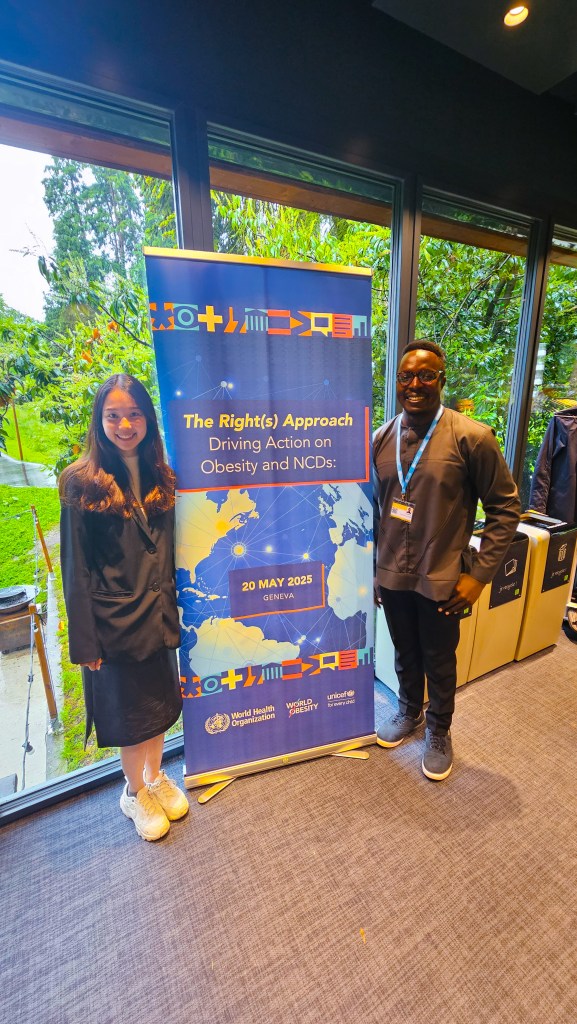
At the 78th World Health Assembly (WHA78) in Geneva, I had the honour of moderating one of the most human-centered and transformative sessions I’ve ever been part of:
“Taking the Right(s) Approach: Driving Action on Obesity and NCDs,” a side event hosted by the Global Obesity Coalition.
In a space often dominated by statistics, policies, and declarations, this conversation reminded us of the power of lived experience as leadership. Alongside fellow advocates from South Africa, Spain, and the European Coalition for People living with Obesity, we held a dialogue grounded not just in data but in reality — our stories, struggles, and strategies.
As a Kenyan health advocate and someone who has lived with obesity, moderating this event wasn’t just about guiding discussion. It was about shaping a global moment where people like me were not invited to speak after the experts — we were the experts.

Reimagining Environments through a Rights-Based Lens
The session brought together policymakers, civil society, UN agencies like WHO and UNICEF, and, most importantly, voices from the community. We explored how rights-based approaches can change the game in tackling obesity and NCDs, especially as we move toward the 2025 UN High-Level Meeting on NCDs and Mental Health.
We asked bold questions:
- What does it mean to grow up in a world where your food environment is shaped by corporate marketing?
- How do we create care systems where stigma is replaced by support?
- What does access to nutritious food and health information look like when you’re poor, rural, or young?
From childhood obesity to the intersections of HIV, mental health, and poverty, the conversation was both personal and political. We reframed obesity not as a failure of individual willpower but as a systemic, rights-linked crisis demanding equity, dignity, and urgent action.

Double Dividend, Shared Solutions
One of the core themes we explored was the idea of a double dividend: that by building rights-affirming systems to tackle obesity, we also strengthen our response to other NCDs, mental health, and even broader health systems.
Drawing from global lessons — from HIV integration to dignity-centered care models — we highlighted how policy rooted in human rights can be more effective, inclusive, and sustainable.

Youth and Africa at the Centre
As someone representing Kenya and the African region, it was critical for me to emphasize that Africa is not a passive observer in the obesity crisis — we are actively engaged, affected, and capable of shaping the response.
We need tools, yes — but we also need trust, inclusion, and leadership roles in the global health agenda.
Moving Forward
This WHA78 side event was not just a panel. It was a challenge to the global community to listen deeply, act boldly, and place lived experience at the heart of policy and program design.

As we approach the UN High-Level Meeting on NCDs in September, I urge governments, donors, and multilateral agencies to not only hear our voices but act on what we’re saying:
That obesity is a human rights issue. That youth, dignity, and equity matter. And that the future of global health will be defined by how seriously we take lived experience — not as a checkbox, but as a compass.

Let’s build systems that don’t just treat disease — but uphold humanity.
 STEPHEN OGWENO
Leave a comment